
From innovation to implementation: reflections on evidence synthesis at EAHIL 2026
Dr M. Denby, Research Adviser & Lead for Literature Searching Services, Library Research Team,
Edward Boyle Library, University of Leeds, UK
In June, I was fortunate to attend EAHIL 2026 in Antalya, Turkey. Its theme, Bridges to New Horizons: Innovations in Health Information and Medical Libraries, framed a programme focused on new technologies and the evolving contribution of health information professionals. As Research Adviser and Lead for Literature Searching Services, I lead a commissioned service that develops literature searches for grant-funded evidence-synthesis projects, mainly systematic and scoping reviews, alongside training, consultations and methodological guidance for doctoral researchers and academic staff. EAHIL offered a valuable opportunity to learn from international colleagues and consider how innovations in AI, systematic searching, screening, researcher development and service provision can be implemented critically and responsibly.
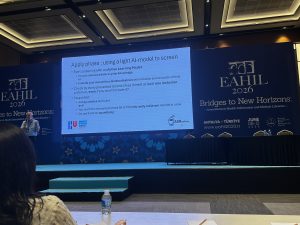
AI was one of the strongest examples of innovation moving towards implementation. Presentations, workshops and posters explored its use across evidence-synthesis workflows, including supplementary searching, search-strategy development, database translation and study screening. What I found most valuable was the consistent framing of AI as support – rather than a replacement – for expert practice. A workshop on using large language models (LLMs) to translate search strategies between databases illustrated this clearly: the tool acted as a translation assistant, while the information specialist remained responsible for checking controlled vocabulary, field codes, proximity operators and database-specific syntax.
The need for expert judgement was also evident in evaluations of AI-assisted retrieval, which suggested that AI tools may identify relevant or unique records, but may also omit studies found through conventional database searching. Questions about relevance, reproducibility and screening burden reinforced a clear message: AI should be incorporated selectively, transparently and critically, not treated as a shortcut. Implementation means asking not only whether a tool can perform a task, but whether its use can be justified, evaluated and reported clearly enough to support critical appraisal.
Sessions on “human-in-the-loop” approaches showed that professional judgement must be built into AI-assisted workflows from the outset. Human oversight is not simply a final check; it shapes tool selection, risk assessment, validation and integration into review processes. I was particularly interested in discussions around RAISE 3, Responsible use of AI in Evidence Synthesis (RAISE 2026): selecting and using AI evidence synthesis tools, as guidance for evaluating AI tool selection, use and reporting. Its prominence across information-specialist events this year, including NIHR’s COREIR Forum and the UHMLG Spring Forum, suggests a wider shift towards more structured, responsible approaches. In the Literature Searching Service I lead, AI-assisted searching is becoming an optional but more formal component of some projects, and this learning will help strengthen how we document tool rationale, checking processes and added value alongside conventional searching.
This emphasis on implementation also carried into established areas of information retrieval. The workshop on search-hedge development and validation traced the process from hedge development and PRESS-informed peer review to testing against known studies and assessing sensitivity and specificity. It was a practical reminder that methodological quality depends on careful design, documentation and evaluation. Sessions on Rayyan, ASReview and active-learning-assisted screening similarly showed that efficiency must be balanced with recall, transparency and risk management. The most convincing innovations were embedded within clear processes: documented decisions, validation, safeguards and human oversight.
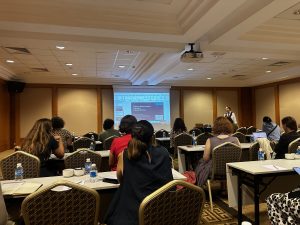
EAHIL also extended the implementation theme from tools and methods to professional roles. A recurring message was that information specialists have “central roles in systematic review teams, including roles beyond searching.” Presentations showed how these contributions span the evidence-synthesis lifecycle, from protocol development and study selection to reporting, methodological guidance, teaching and co-authorship. Beyond Searching: The Evolving Role of Information Specialists in Evidence Synthesis Partnerships resonated strongly with my service context. In our commissioned Literature Searching Service, we discuss authorship recommendations with research teams and identify co-authorship as our preferred model where information specialists make substantive contributions and authorship criteria are met. The poster Charting Services for Evidence Synthesis added a useful service-design perspective by comparing advisory, collaborative or embedded, and fee-based models. Together, these sessions strengthened the case for information specialists as integral contributors to research quality, transparency and methodological rigour.
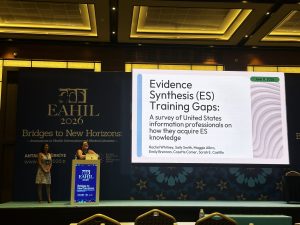
Learning from EAHIL will feed directly into practice at Leeds. In service development, I will use these insights to strengthen how we plan, document and evaluate supplementary AI searching within commissioned evidence-synthesis projects. In researcher development, the workshops I have recently co-developed on AI tools across the literature-review workflow will draw more explicitly on conference evidence around sensitivity, precision, reproducibility and transparency. Rather than focusing mainly on what tools can do, these sessions will give greater attention to when tools are appropriate, how outputs should be assessed, and what safeguards are needed before they are incorporated into review workflows. This will help embed critical appraisal, methodological decision-making and responsible AI use within our training offer.
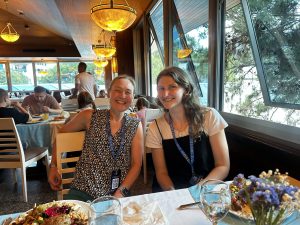
Beyond the formal programme, EAHIL was an exceptionally welcoming professional community. As a first-time attendee, I appreciated the openness with which delegates shared experiences, challenges and ideas. The First Timers’ Welcome Reception helped establish connections early, while conversations during workshops, breaks and social events created opportunities to compare practice across institutional and national contexts. I returned from Antalya with practical approaches to test, services to refine and professional relationships to develop. For me, EAHIL 2026 underlined that moving towards new horizons is not simply about adopting new technologies, but about combining innovation with methodological expertise, careful evaluation, collaboration and an ongoing commitment to high-quality evidence.